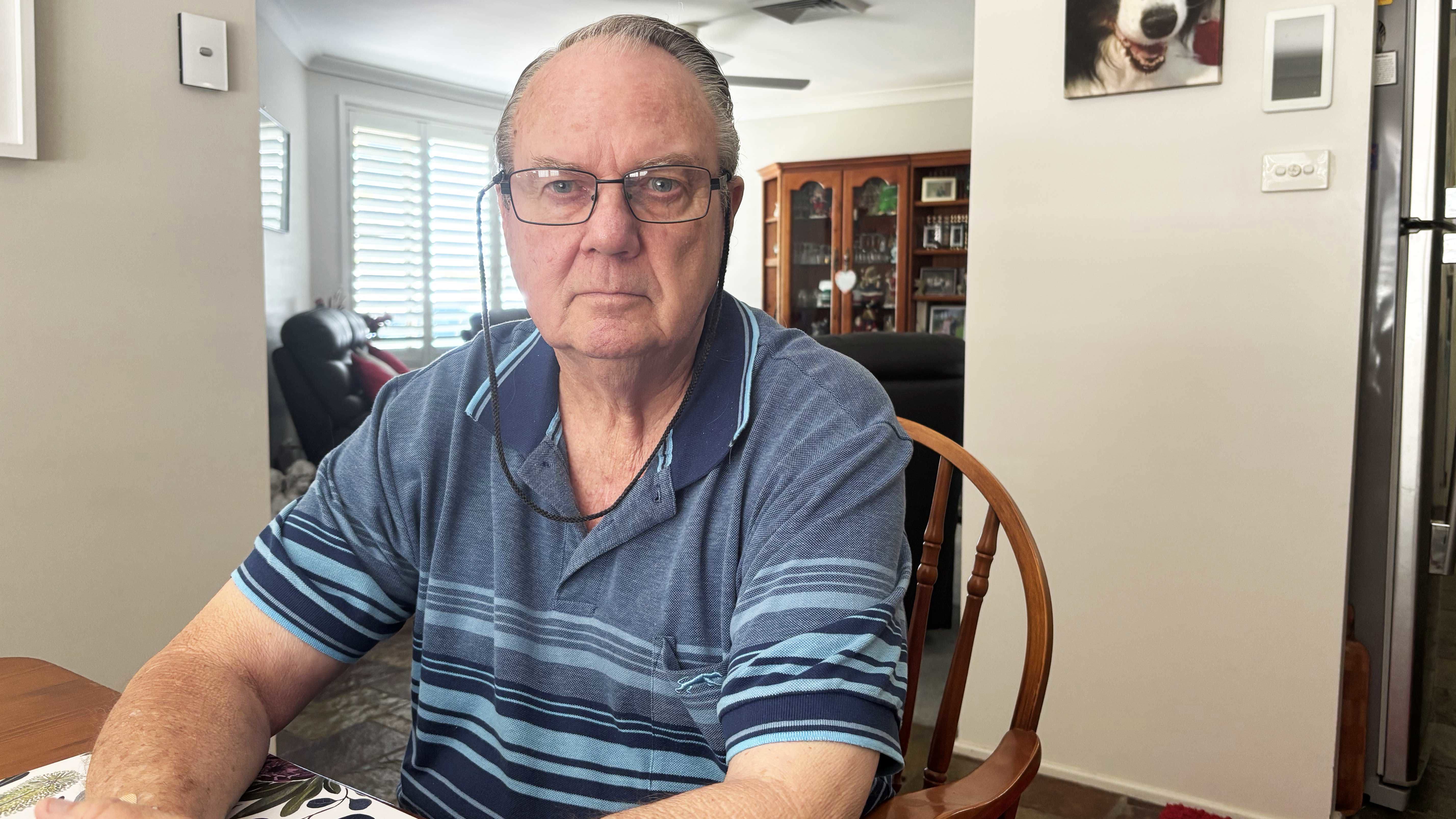
At 74 years old, Larry Allison still gets up at 5.15 am two days a week - not out of choice, but necessity.
At 74 years old, Larry Allison's alarm clock still goes off at 5.15am two days a week.
While many his age are enjoying a quiet retirement, the former merchant banker and removalist is climbing behind the wheel of a school bus in Port Stephens, on the north coast of New South Wales, for his part-time job.
Allison is one of a growing number of Australian seniors who have discovered that a lifetime of hard work isn't enough to keep up with a modern cost-of-living crisis.
He told nine.com.au he simply couldn't survive the increases in all of his major expenses if he didn't keep working.
"Everything just keeps going up - more than the rate of inflation," he said.
"Over the last 12 months, our electricity is up 33 percent, insurance has gone up by 20 percent, and it just doesn't stop."
READ MORE: Truck driver's warning as diesel shortage poses deadly risk
Allison originally thought he would retire at 65. Now, he estimates he will have to keep working until he is at least 80.
In a recent Change.org petition started by Allison, the pensioner laid bare the reality of his "golden years."
"I wake up each week knowing that I still have to work two days just to keep my head above water," Allison wrote.
"I am an age pensioner, and after a lifetime of hard work, it's disheartening to see that I can't afford to slow down and enjoy my golden years at home.
"Instead, I am forced to continue working because the cost of living has become unbearable."
Pensioners working longer than ever
Allison's struggle is reflected in a nationwide trend of Australians delaying full retirement.
According to the latest Household, Income and Labour Dynamics in Australia (HILDA) survey data, retirement rates have plummeted over the last two decades.
In 2003, roughly 70 percent of women and nearly half of men aged 60 - 64 had fully retired. Today, those numbers have fallen to 41 percent and 27 percent respectively.
Even for those in their late sixties (65–69), retirement is no longer a given: only 66 percent of women and 61 percent of men in this age bracket are fully retired, down from much higher levels twenty years ago.
The physical and mental toll of working into one's late seventies is significant.
To keep his heavy vehicle licence, Allison undergoes annual driving tests and check-ups with an endocrinologist, a heart specialist, and a GP. This year, a cognitive test will be added.
"I had open-heart surgery three years ago... but I still managed to get back to work," he said.
Calls for reform: "Let pensioners work"
A common frustration for many working seniors lies with the pension income test.
Currently, once a single pensioner earns over $218 a fortnight (or $380 for a couple), their pension payments are reduced by 50 cents for every dollar earned.
"When I was working three or four days a week, I was losing 50 cents in every dollar, plus paying 30 cents in tax," Allison said. "There was no point."
This sentiment is at the heart of the National Seniors Australia (NSA) "Let Pensioners Work" campaign.
The NSA is lobbying the government to exempt employment income from the Age Pension income test entirely.
They argue the current system effectively "taxes" seniors at a higher marginal rate than many high-income earners, discouraging them from filling critical labour shortages in sectors like aged care and agriculture.
Billy Pringle, Senior Policy Officer for the Combined Pensioners & Superannuants Association (CPSA), said the cost-of-living squeeze was becoming unbearable for many pensioners.
While the pension is indexed to the CPI, Pringle points out that those increases always arrive after the prices have already spiked.
"Pensioners are always having to play catch-up," Pringle said.
"We've heard from people who are eating less nutritious meals because they aren't able to get fresh fruit and vegetables... or they might be skipping meals altogether."
Pringle warns that for those who aren't physically able to "pick up an extra shift" like Allison, the situation is dire.
"People have paid tax their whole life with the promise that they can retire, and then they are forced back into the workforce because of circumstance."
The shifting safety net
To prevent the pension from losing its value, the government uses a complex "triple-check" system for indexation every March and September.
It compares the Consumer Price Index (CPI), which measures general inflation, with the Pensioner and Beneficiary Living Cost Index (PBLCI), which is tailored to the specific spending patterns of seniors - like higher healthcare and energy costs. The pension is increased by whichever of these two is higher.
Finally, the rate is benchmarked against Male Total Average Weekly Earnings to ensure pensioners' living standards don't fall too far behind those of workers.
However, Pringle points out that these metrics often fail to capture the true financial burden on individuals, noting that while rent factors in at about 6 percent of the CPI and 20 percent of the PBLCI, "there's very few people for whom rent is only six or even 20 percent of their income and of their costs; mostly it's north of 30 percent."
While these shifts happen twice a year, they are often overshadowed by the "Work Bonus" rules.
In late 2023, the federal government made significant reforms to this scheme, permanently increasing the "Work Bonus Bank" limit from $7800 to $11,800.
This allowed new pensioners to start with a $4000 credit, theoretically letting them earn more from a job before their pension began to dwindle.
However, for Allison and thousands of others, even these "banked" credits disappear quickly under the weight of bill shock coming in.
"We just got our last electricity bill, it was $954 for the last quarter, and we have also just paid our rates - there goes another $2700," Allison said.
NEVER MISS A STORY: Get your breaking news and exclusive stories first by following us across all platforms.
- Download the 9NEWS App here via Apple and Google Play
- Make 9News your preferred source on Google by ticking this box here
- Sign up to our breaking newsletter here
 Trump's grim reason for failing to reach a deal
 Islamic State speech 'likely inspired' alleged Bondi shooting, terror experts say
 Cyclone expected to deliver massive 'rain dump', flash flooding to Perth
 Ground invasion of Iranian island a 'mistake', says expert
 Estranged wife of Sydney dentist shot dead by police reveals abuse
 Sydney teacher charged after allegedly grooming 14-year-old girl
 Neo-Nazi leader Thomas Sewell to stand trial over alleged camp attack
 Iranian ally could cause chaos if drawn into the war
 Travelling family left blindsided by $500 tank of fuel
 Truckie left stranded twice on remote highways as diesel runs dry
 Police release footage of the moment men storm Sydney kebab shop in shooting
 Tradies hit hardest by fuel crisis forced to raise prices or go bust
 'My kids' lives mean nothing': Mum sobs as 'callous' driver jailed
 Identity of 'major player' charged with Sydney grandfather's murder revealed
 Iran looking to turn Strait of Hormuz into massive toll booth
 'They're screaming out for it': Hanson's warning after election shock
 Sydney Opera House sails light up to mark 50 Years of Apple
 Trump on shaky ground after Democrats win Mar-a-Lago seat
 Motorists flock to tiny growers mart selling city's cheapest fuel